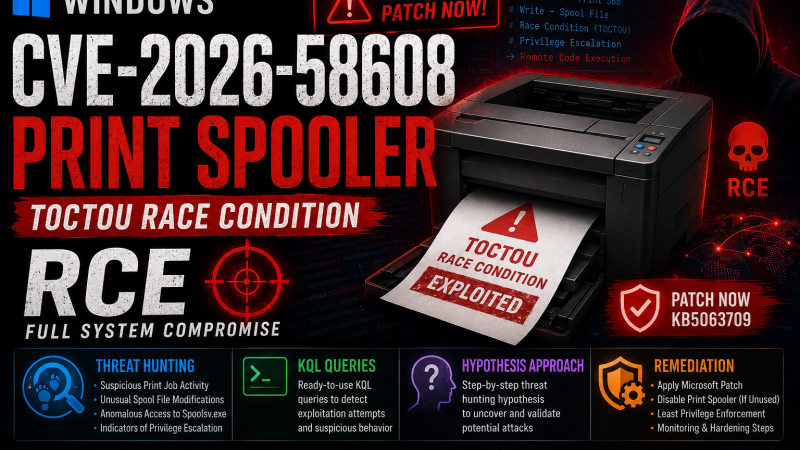
Every few years, a vulnerability class resurfaces with enough nuance to deserve fresh analysis. Windows Print Spooler has been exploited since at least 2010, but CVE-2026-58608 introduced a twist that previous PrintNightmare variants did not: a TOCTOU (Time-of-Check Time-of-Use) race condition paired with a use-after-free memory corruption primitive. When I started pulling apart the Vicarius vulnerability research on this CVE, it became clear that this is not just another spooler patch.
Microsoft patched CVE-2026-58608 on July 14, 2026 as part of one of the largest Patch Tuesday cycles in Microsoft’s history (622 CVEs across the full release). The vulnerability sits at CVSS 8.8 with a vector of AV:N/AC:L/PR:L/UI:N/S:U/C:H/I:H/A:H. That attack profile — network-accessible, low-complexity, low-privilege required, no user interaction — makes it a priority target in any environment where the Print Spooler service remains active on servers or domain controllers.
The Print Spooler Vulnerability Class That Won’t Die
PrintNightmare (CVE-2021-34527) forced many organizations to disable the Print Spooler service on domain controllers. Then SpoolFool (CVE-2022-21999) followed. Then CVE-2023-21823. The pattern is consistent: Microsoft patches the immediate exploitation path, researchers find an adjacent primitive, and the cycle repeats. The root cause has never been a single bug. It is an architectural problem in how the spooler handles shared resources across security boundaries.
The Print Spooler service runs as SYSTEM by default. Any code injected into the spooler process inherits SYSTEM-level privileges. That is the core reason this attack class remains so attractive to threat actors. Even a network-accessible bug that escalates from a standard domain user to SYSTEM dramatically expands the blast radius of any compromise. For Red Teams, this class of vulnerability represents a reliable lateral movement and privilege escalation path that does not require dropping additional tools.
CVE-2026-58608 shares DNA with PrintNightmare in terms of the targeted subsystem, but the exploitation mechanism is distinct. Prior variants largely abused AddPrinterDriverEx or RpcAddPrinter to load arbitrary DLLs from attacker-controlled paths. CVE-2026-58608 operates at a lower level: the shared memory regions that spoolsv.exe uses to communicate printer queue status, driver configuration, and security descriptors between processes.
What CVE-2026-58608 Actually Is
The vulnerability exists in the Windows Print Spooler service and involves two overlapping CWE classifications: CWE-362 (Concurrent Execution Using Shared Resource with Improper Synchronization) and CWE-416 (Use After Free). These two weaknesses interact to create the exploitable condition, and understanding their relationship is key to understanding why the patch was non-trivial.
The Print Spooler manages printer queue entries, driver configurations, and security descriptors through shared memory regions. When a process creates a printer handle and performs operations against it, the spooler validates security descriptors before executing the requested action. That validation check (the “time of check”) and the subsequent action (the “time of use”) are not atomic. There is a window between them, and CVE-2026-58608 is about exploiting that window with precision.
The use-after-free component introduces the memory corruption angle. When a printer handle is closed while a related change notification handle is still open, the spooler can be manipulated into continuing to reference memory associated with the closed handle. If an attacker controls what data occupies that freed memory region at the moment the spooler follows the dangling pointer, they can redirect execution or corrupt privilege-relevant data structures within the spooler process.
CVSS Vector Breakdown
Full vector: CVSS:3.1/AV:N/AC:L/PR:L/UI:N/S:U/C:H/I:H/A:H
- AV:N (Attack Vector: Network) — The Print Spooler exposes RPC interfaces over the network via MS-RPRN (Microsoft Remote Printing Protocol). Exploitation does not require physical access or pre-existing local code execution. A domain-authenticated attacker can reach the spooler’s RPC endpoint directly from any host on the network.
- AC:L (Attack Complexity: Low) — The race condition window is wide enough that precise per-microsecond timing is not required. Vicarius documented reliable exploitation within 3 to 5 attempts in lab conditions, with each attempt taking approximately 12 to 20 seconds.
- PR:L (Privileges Required: Low) — Standard domain user account is sufficient. No administrative credentials, no token impersonation, no special group membership is required to reach the vulnerable code path.
- UI:N (User Interaction: None) — No phishing, no file execution, no click required from any user. Network-based, fully automated exploitation is achievable.
- C:H/I:H/A:H — Full compromise of confidentiality, integrity, and availability. Successful exploitation yields SYSTEM-level control over the target.
A raw CVSS of 8.8 does not fully capture the operational risk in domain environments. Because Print Spooler frequently runs on domain controllers for Group Policy printer deployment and legacy print server workflows, successful exploitation of CVE-2026-58608 on a DC translates directly to domain compromise.
The TOCTOU Mechanism Step by Step
Phase 1: Establishing the Race Window
An attacker begins by authenticating to the target system with low-privilege domain credentials. Using the Windows Print Spooler RPC interface, they open a printer handle via RpcOpenPrinter or RpcOpenPrinterEx. This is a standard, authenticated operation that requires only the SERVER_ACCESS_ENUMERATE right, which every domain user holds by default.
Simultaneously, the attacker registers a change notification on that printer handle using RpcRemoteFindFirstPrinterChangeNotificationEx. Printer change notifications use a separate kernel object that persists independently of the printer handle itself. This creates the structural condition for the race: two different objects tied to the same printer, but with separate lifecycles — one of which will survive the closure of the other.
Phase 2: Memory Corruption via Use-After-Free
The attacker rapidly closes the printer handle while keeping the notification handle open. The spooler frees the memory associated with the closed printer object. At this moment, the notification handle holds a dangling pointer: it references memory that has been freed but not yet reclaimed by a new allocation.
Using controlled allocation spraying, the attacker fills the freed memory region with attacker-controlled data. Objects that the attacker can influence — printer names, driver configuration buffers, security descriptor payloads crafted via normal spooler API calls — are allocated to occupy the freed space. When the spooler subsequently processes a notification event and follows the dangling pointer, it reads or writes attacker-controlled data instead of legitimate printer object data.
Phase 3: Code Injection and Privilege Escalation
Depending on exactly what spoolsv.exe does with the corrupted pointer, exploitation leads to either arbitrary code execution within the spooler process itself (which runs as SYSTEM) or corruption of a privilege token structure that allows impersonation of SYSTEM context. From there, standard post-exploitation proceeds: credential harvesting, lateral movement, persistence establishment, or ransomware deployment.
The Vicarius vsociety platform documented PoC exploitation against Windows 11 24H2 in controlled lab conditions. Their analysis confirmed that the exploitation path is reliable with minimal tuning once the race window timing is understood for a target configuration.
Affected Products and Patch Status
| Operating System | Affected Versions | Patch KB |
|---|---|---|
| Windows 10 | 1607, 1809, 21H2, 22H2 | KB5099539 (22H2) |
| Windows 11 | 24H2, 25H2, 26H1 | KB5101649 (26H1) |
| Windows Server 2016 | All builds | July 2026 cumulative |
| Windows Server 2019 | All builds | July 2026 cumulative |
| Windows Server 2022 | All builds | July 2026 cumulative |
Microsoft classified this as network-exploitable requiring low privileges at the time of patching. It was not marked as actively exploited in the wild as of patch release, but given the reliable exploitation profile and the PrintNightmare lineage, in-the-wild exploitation should be assumed for any unpatched systems at this point.
MITRE ATT&CK Mapping
| Technique | ID | Application |
|---|---|---|
| Exploitation for Privilege Escalation | T1068 | Race condition exploitation for SYSTEM escalation |
| Exploitation of Remote Services | T1210 | RPC-based network exploitation pre-foothold |
| OS Credential Dumping | T1003 | Post-SYSTEM credential harvesting |
| Create or Modify System Process | T1543 | Spooler-injected code modifying service behavior |
| Lateral Tool Transfer | T1570 | Using spooler as delivery vector for next-stage payloads |
Threat Hunting Queries
The detection approach here targets three distinct signals: unusual child processes from spoolsv.exe, non-standard DLL loads within the spooler, and service-level manipulation events. In isolation, any one of these can produce false positives (print driver installation generates all three). In correlation, particularly when they occur within a narrow time window from a single host, confidence in active exploitation is high.
Microsoft Sentinel KQL
Detect unexpected processes spawned by the Print Spooler:
DeviceProcessEvents
| where TimeGenerated > ago(7d)
| where InitiatingProcessFileName =~ "spoolsv.exe"
| where FileName !in~ (
    "conhost.exe", "WerFault.exe", "wermgr.exe",
    "splwow64.exe", "PrintIsolationHost.exe", "PrintBrmUi.exe"
  )
| project TimeGenerated, DeviceName, AccountName, FileName,
          ProcessCommandLine, InitiatingProcessCommandLine
| order by TimeGenerated desc
Hunt for non-standard DLL loads within the spooler (driver injection path):
DeviceImageLoadEvents
| where TimeGenerated > ago(7d)
| where InitiatingProcessFileName =~ "spoolsv.exe"
| where not(FolderPath has_any (
    @"C:WindowsSystem32",
    @"C:WindowsSysWOW64",
    @"C:WindowsFonts",
    @"C:WindowsPrintDialog"
  ))
| project TimeGenerated, DeviceName, FolderPath, FileName, SHA256, Signer
| order by TimeGenerated desc
Correlate spooler anomalies with recent authentication events to identify the source account:
let SpoolerAnomalies = DeviceProcessEvents
| where TimeGenerated > ago(1h)
| where InitiatingProcessFileName =~ "spoolsv.exe"
| where FileName !in~ ("conhost.exe","WerFault.exe","wermgr.exe","splwow64.exe")
| project AnomalyTime = TimeGenerated, AnomalyHost = DeviceName, AnomalyProcess = FileName;
let RecentAuths = IdentityLogonEvents
| where TimeGenerated > ago(2h)
| where LogonType in ("Network", "RemoteInteractive")
| project AuthTime = TimeGenerated, AuthHost = DeviceName, AuthUser = AccountName, AuthIP = IPAddress;
SpoolerAnomalies
| join kind=leftouter RecentAuths on $left.AnomalyHost == $right.AuthHost
| where AnomalyTime >= AuthTime and AnomalyTime <= datetime_add('minute', 30, AuthTime)
| project AnomalyTime, AnomalyHost, AnomalyProcess, AuthUser, AuthIP, AuthTime
Splunk SPL
index=sysmon EventCode=1 ParentImage="*\spoolsv.exe"
NOT Image IN (
  "*\conhost.exe","*\WerFault.exe","*\wermgr.exe",
  "*\splwow64.exe","*\PrintIsolationHost.exe"
)
| table _time, host, user, Image, CommandLine, ParentCommandLine
| eval alert="CVE-2026-58608: Suspicious child of spoolsv.exe"
index=sysmon EventCode=7 Image="*\spoolsv.exe"
NOT ImageLoaded IN ("*\System32\*","*\SysWOW64\*","*\Fonts\*","*\PrintDialog\*")
| table _time, host, ImageLoaded, Signed, Signature
| eval alert="CVE-2026-58608: Non-standard DLL in Print Spooler"Sigma Rule
title: CVE-2026-58608 Suspicious Child Process from Windows Print Spooler
id: d3f4a2b8-5c6e-4d9f-8a1b-7e2c3f5d8a9b
status: stable
description: >
  Detects unusual processes spawned by spoolsv.exe which may indicate
  exploitation of CVE-2026-58608 Windows Print Spooler TOCTOU race condition
  or similar PrintNightmare-lineage vulnerabilities.
references:
  - https://nvd.nist.gov/vuln/detail/CVE-2026-58608
  - https://msrc.microsoft.com/update-guide/vulnerability/CVE-2026-58608
author: vivekverma.in
date: 2026/07/30
tags:
  - attack.execution
  - attack.t1203
  - attack.privilege_escalation
  - attack.t1068
  - cve.2026-58608
logsource:
  category: process_creation
  product: windows
detection:
  selection:
    ParentImage|endswith: 'spoolsv.exe'
  filter_legit:
    Image|endswith:
      - 'conhost.exe'
      - 'WerFault.exe'
      - 'wermgr.exe'
      - 'splwow64.exe'
      - 'PrintIsolationHost.exe'
      - 'PrintBrmUi.exe'
  condition: selection and not filter_legit
falsepositives:
  - Print driver installation spawning temporary helper processes
  - Legitimate third-party print management software
level: high
Mitigation Priorities
Apply July 2026 cumulative updates to all Windows systems immediately. For Windows 10 22H2 systems, the relevant article is KB5099539. For Windows 11 26H1, apply KB5101649. Server editions are covered in the July 2026 monthly rollup for their respective versions.
For domain controllers specifically: Microsoft has recommended disabling Print Spooler on DCs since PrintNightmare. If any domain controllers in your environment still run the Spooler service in 2026, patch status is secondary to service disablement. Disable it regardless of patch status, then patch, then reassess whether re-enabling is actually required for any operational workflow. In almost every case, it is not. Group Policy-based printer deployment does not require Spooler on the DC itself.
The temporary network-level workaround for environments that cannot patch immediately:
New-NetFirewallRule -Name "BlockSpoolerRPC" `
  -DisplayName "Block Remote Print Spooler RPC" `
  -Direction Inbound -Protocol TCP `
  -LocalPort 135,445 -RemoteAddress Any `
  -Action Block -Profile Domain,Private -Enabled True
This blocks the RPC transport path that CVE-2026-58608 requires for network exploitation. It will not affect locally initiated printing, but it does prevent remote attack from other network hosts. For the full post on how Print Spooler compares to other network-accessible service exploitation paths, the Volt Typhoon campaign analysis on this site covers how nation-state actors chain spooler-class vulnerabilities into broader infrastructure compromise without dropping tools: Volt Typhoon Threat Hunting and LOTL Detection.
External references: NVD CVE-2026-58608 | Microsoft Security Response Center | KB5099539 Windows 10 22H2