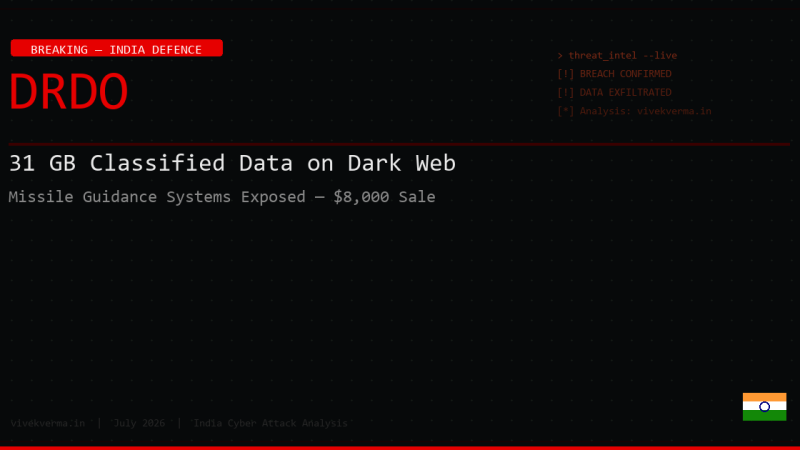
Breaking (July 27, 2026): A threat actor is advertising 31 GB of allegedly stolen data from India’s Defence Research and Development Organisation (DRDO) on the dark web for $8,000. The listing includes sample files containing internal electronics architecture of advanced missile guidance sensors used in precision-guided munitions. Indian intelligence agencies have flagged the potential breach. DRDO has not issued an official statement confirming or denying the exfiltration.
India’s premier defence research and development body, the Defence Research and Development Organisation (DRDO), is at the centre of a serious cybersecurity alarm that broke on July 27, 2026. A dark web threat actor has listed what they claim to be 31 gigabytes of stolen classified data — including the internal architecture of electronics used in India’s advanced missile guidance systems — for sale at $8,000.
The listing, first spotted by cybersecurity researchers monitoring dark web forums and later reported by The Week and The Print, represents one of the most alarming potential defence data breaches India has seen in years. If the data is genuine, the implications stretch from national security to operational secrecy across India’s entire strategic missile programme.
This is a complete analysis of what we know, what it means, and what it exposes about the state of cybersecurity at India’s most sensitive research institutions.
What Was Allegedly Stolen?
According to the dark web listing, the stolen dataset includes:
- Internal electronics architecture of an advanced guidance sensor used in precision-guided missiles and smart munitions — including circuit schematics, component specifications, and signal processing logic
- Technical documentation related to missile guidance, navigation, and control (GNC) systems
- Research papers and internal reports from DRDO laboratories
- Personnel and project data — the full scope of which is not publicly confirmed
Sample files posted by the actor as proof-of-authenticity include detailed documentation of guidance sensor electronics — material that would be classified under India’s Official Secrets Act. The samples were independently verified by multiple cybersecurity researchers as appearing authentic in format and technical vocabulary.
However, a critical detail adds uncertainty: the sample documents carry dates from 2020. This raises questions about whether this is a newly executed breach or whether data stolen years ago is only now being monetised — a pattern increasingly common in dark web operations where actors hoard data and sell it when geopolitical timing maximises value.
The Threat Actor: Babuk2 / Babuk Locker
The dark web post claiming responsibility has been linked to Babuk2 (also referred to as Babuk Locker), a ransomware and data extortion group with a history of targeting government, defence, and critical infrastructure organisations globally.
Babuk2 emerged in 2021 after the original Babuk ransomware source code was leaked, allowing multiple threat actors to use the same codebase. By 2025-2026, Babuk2 operators had repositioned as a data extortion group — stealing and selling sensitive data rather than deploying encryption-based ransomware. Their past victims include law enforcement agencies and defence contractors in the US, Europe, and Asia.
The group’s modus operandi typically involves:
- Initial access through spear-phishing of privileged employees or via exposed VPN appliances
- Lateral movement to high-value file servers and document management systems
- Mass data exfiltration — often over weeks — before any detection
- Listing on dark web markets with proof-of-data samples to attract buyers
What Is DRDO and Why Does This Matter?
DRDO is India’s primary military research agency, operating under the Ministry of Defence. With over 50 laboratories and 30,000+ employees across India, DRDO is responsible for developing some of India’s most sensitive defence technologies, including:
- Agni and Prithvi missile systems — India’s strategic nuclear and conventional ballistic missiles
- BrahMos (in collaboration with Russia) — supersonic cruise missile
- Astra — beyond-visual-range air-to-air missile
- Tejas — indigenous light combat aircraft
- Advanced radar systems, sonar technology, electronic warfare systems, and armoured vehicles
The guidance sensor electronics allegedly included in this breach would directly relate to how India’s precision-guided munitions navigate to their targets. If adversary nations obtained this data, they could:
- Develop countermeasures to jam or spoof India’s missile guidance systems
- Identify vulnerabilities in the sensor architecture
- Reverse-engineer production techniques for competitive intelligence
- Map the supply chain of components used in India’s defence systems
How Did the Data Leave DRDO? Attack Vectors to Investigate
DRDO operates a classified network — the DRONA (DRDO Research and Development Operation Network for Applications) — which is air-gapped from the public internet. However, several pathways could explain the alleged exfiltration:
1. Insider Threat
India has a documented history of DRDO insider threats. The DRDO espionage cases of 2014–2018 saw multiple scientists arrested for passing technical information to foreign intelligence services via physical media or personal email accounts. A compromised insider with legitimate access to classified documents remains the most likely vector for air-gapped network breaches.
2. Third-Party Contractor Compromise
DRDO works extensively with private sector vendors for component procurement, testing, and manufacturing. These contractors often have partial access to technical specifications. A breach of a contractor’s network (which may not be air-gapped) could expose classified design documentation that contractors were authorised to receive.
3. Internet-Connected Administrative Systems
While DRDO’s core research networks are air-gapped, administrative and communication systems are connected to the internet. Spear-phishing attacks against DRDO employees on these systems, followed by credential theft and pivot to file-sharing systems, is a documented vector in similar agencies globally.
4. Data from a Previous Breach Being Resold
Given the 2020 document dates, this may be data from a breach that occurred years ago — possibly during the 2020–2021 period when DRDO faced multiple cyberattack attempts linked to the China-India border tensions at Galwan Valley. Post-Galwan, multiple Indian government and defence networks reported increased APT activity, and some data may have been exfiltrated at that time without public disclosure.
The Dark Web Economy Around Indian Defence Data
The $8,000 asking price for 31 GB of DRDO data is surprisingly low — suggesting either that the actor is motivated by rapid liquidity rather than maximum value, or that this is a negotiation opening bid. In dark web intelligence markets, verified defence data from major military powers typically commands anywhere from $50,000 to several million dollars depending on sensitivity and freshness.
The low price point raises two possibilities:
- The data may be less sensitive than advertised — perhaps superseded technical documentation rather than current operational systems
- The actor may be testing market interest while negotiating privately with higher-value buyers, including potentially state-level intelligence services
Past DRDO Security Incidents
This is not the first time DRDO’s data security has been questioned:
- 2022: Multiple DRDO laptops reported stolen or missing during transit between laboratories, raising concerns about physical data security
- 2021: CERT-In warned of targeted phishing campaigns against Indian defence and aerospace sector employees
- 2020 (Galwan period): Chinese APT groups significantly escalated operations against Indian defence, government, and power sector targets following the border clash
- 2012–2018: Multiple DRDO scientists arrested for espionage — passing technical data to Pakistan’s ISI
India’s Defence Cybersecurity Gap
India spends approximately $72 billion annually on defence but the cybersecurity budget for protecting that investment remains critically underfunded relative to the threat level. Key gaps include:
- No unified Defence Cyber Command: Unlike the US (USCYBERCOM) or China (Strategic Support Force), India’s cyber defence remains fragmented across NTRO, DRDO’s own IT teams, the Defence Information Assurance and Research Agency (DIARA), and service-specific units
- Contractor security standards: Private sector vendors supplying DRDO often operate under outdated security requirements, creating third-party attack surfaces
- Insider threat detection: DLP (Data Loss Prevention) systems and user behaviour analytics are inconsistently deployed across DRDO’s 50+ labs
- Legacy IT infrastructure: Many DRDO labs operate on ageing systems that have not received security patches, making them vulnerable to known exploits
What Should Happen Now?
Whether or not this specific breach is confirmed, the incident should trigger immediate action:
- Forensic investigation across all DRDO labs: Audit file access logs for the period 2019–2021 specifically, focusing on the guidance sensor project files referenced in the samples
- Dark web intelligence sweep: Contract threat intelligence vendors to purchase sample data and perform forensic attribution of the exfiltration method
- Contractor security audit: Immediately audit cybersecurity posture of all vendors with access to classified technical specifications
- NCIIPC escalation: The National Critical Information Infrastructure Protection Centre should treat this as a live national security incident regardless of the breach timeline
- Employee awareness: Mandatory cybersecurity refresher training for all DRDO employees with access to classified systems, with special focus on spear-phishing and physical security
Implications for India’s Strategic Position
In the context of India’s current geopolitical environment — active Line of Actual Control (LAC) tensions with China, ongoing Pakistan-India cyber operations, and India’s positioning as a major defence exporter — a breach of missile guidance data carries consequences beyond the immediate technical disclosure:
- It signals to adversaries that India’s classified networks have accessible vulnerabilities
- It may damage trust with defence partners like France (Rafale), Russia (S-400), and the US who share technology under joint projects
- It potentially triggers review clauses in technology transfer agreements
Conclusion
The alleged DRDO data breach of 2026 is a stark reminder that national security is increasingly inseparable from cybersecurity. Missile systems are only as secure as the networks that hold their design data. Whether this breach is confirmed or ultimately proves to be aged, recycled data — the fact that a threat actor is advertising 31 GB of DRDO-attributed files on the open dark web is a national security failure that demands immediate and transparent investigation.
India’s defence cybersecurity apparatus needs urgent, structural modernisation — not just reactive patching after each incident. For organisations in the defence supply chain looking to assess their own security posture, contact Vivek Verma for a comprehensive security assessment.
Sources: The Week — DRDO Data Breach Report | The Print — Defence Ministry Data on Dark Web | RedPacket Security — Babuk2 Claim