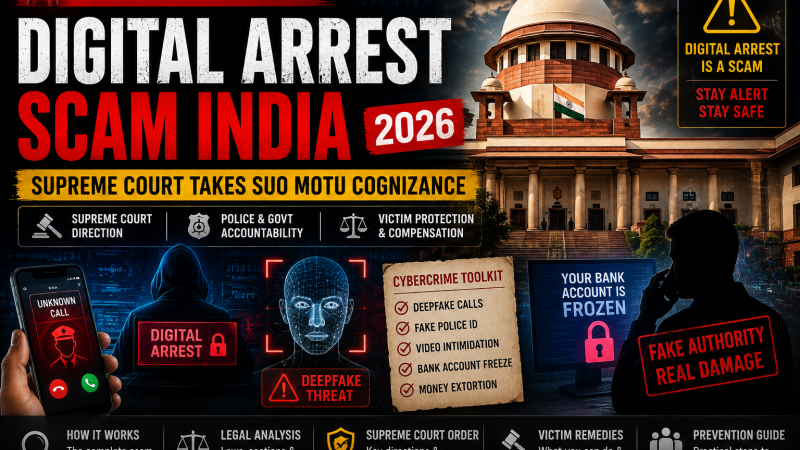
On July 29, 2026, the Supreme Court of India did something that demands broader public attention. A bench led by Chief Justice Surya Kant heard a suo motu case on digital arrest fraud and directed the Union government to formally define “digital arrest” as a standalone criminal offence under Indian law – one carrying harsher penalties than currently exist in the Bharatiya Nyaya Sanhita 2023.
This is not just a legal development worth noting in the judiciary columns. It is a public health announcement about a form of organised fraud that has now, by I4C’s own data, claimed over Rs 22,000 crore from Indian citizens and destroyed lives across every demographic – retired teachers, IIT professors, senior bureaucrats, doctors and at least one former senior police officer.
I am writing this as both a cybersecurity researcher who studies how these attacks are technically constructed, and as a cybercrime lawyer who has seen what they do to victims in the aftermath. You need to understand this threat precisely, because it is specifically designed to defeat your rational thinking.
What Is a Digital Arrest Scam: The Technical and Psychological Anatomy
The term “digital arrest” is a social engineering construct. There is no such thing under Indian law. No police officer, CBI agent, ED official, RBI regulator or judge has the authority to place someone under “digital arrest” via a video call. This is the foundational fact that makes the scam work: most people do not know this.
Here is how a typical attack unfolds.
Stage 1: The Initial Contact
The victim receives a call – often on WhatsApp – from someone claiming to be from TRAI, the Mumbai Police Cyber Crime Wing, the Central Bureau of Investigation or the Enforcement Directorate. The caller states that a mobile number, bank account or Aadhaar registered in the victim’s name has been used in a crime – typically money laundering, drug trafficking or CSAM distribution.
The voice is calm, authoritative and uses official-sounding terminology. In many cases, the caller has already sourced the victim’s name, address, partial PAN or bank details from data brokers, creating immediate credibility that this is a genuine government contact.
Stage 2: Escalation and Visual Authority
The victim is transferred to a “senior officer” on a WhatsApp or Skype video call. The person on the video call wears a police uniform or formal clothes. Behind them is an office environment – often a fabricated set built inside a fraud compound in Cambodia, Myanmar or Laos – with a CBI logo, government posters and stacked files.
In sophisticated attacks, deepfake technology is now being used to overlay a convincing government official’s face onto the fraudster’s video stream in real time. I address this in detail in the section below.
Stage 3: The “Digital Arrest”
The “officer” tells the victim they are now under “digital arrest” – meaning they cannot leave their location, cannot contact family, cannot speak to anyone until the “investigation” is completed. They must remain on the video call at all times. Some victims have remained on these calls for 24 to 72 consecutive hours.
The psychological principle at work is isolation combined with authority and manufactured fear. A person who genuinely believes a CBI officer is watching them through their phone camera, who has been told they may face years in prison for crimes they did not commit, and who has been cut off from family support, becomes highly susceptible to compliance with any demand.
Stage 4: Extortion
The victim is told their assets need to be “verified” to clear their name. They are asked to transfer money to a “government-controlled secure account” for the duration of the investigation. Once the investigation completes, the money will be returned. It never is.
A 74-year-old retired teacher in Bengaluru transferred Rs 24 crore across 26 separate transactions over 2.5 months before a family member noticed. An elderly couple in Maharashtra lost Rs 1.5 crore – the case that triggered the Supreme Court’s suo motu proceedings. A 92-year-old in Delhi was duped of Rs 2 crore; Delhi Police recovered the funds and arrested the network.
The Deepfake Escalation: The Threat That Changes Everything
The intersection of digital arrest fraud and AI-generated media is the most concerning development I am tracking in 2026.
Until 2024, digital arrest scams relied on human actors, uniforms and fabricated office sets to establish visual authority. The limiting factor was visual deception quality – a victim who examined the “CBI office” carefully sometimes noticed inconsistencies.
Deepfake technology has removed that limitation.
India is projected to see 8 million deepfake-generated images and videos in 2025, an increase of approximately 900% year-on-year. The quality of real-time face-swapping technology now available – much of it as open-source software – means a fraudster can conduct a live video call while appearing to be anyone: a known government official, a family member, a public figure.
In the Nirmala Sitharaman case, fraudsters used a deepfake video of the Finance Minister to convince a homemaker that the government had launched an investment program. That was a passive deepfake in a pre-recorded video. Active deepfakes, used in real-time video calls, are now being deployed in digital arrest operations.
Justice Bagchi of the Supreme Court noted during the July 29 proceedings that “courts cannot create new crimes under Article 142” but that the legislature must act specifically on deepfake-enabled fraud given how dramatically it amplifies harm. This urgency connects directly to the broader pattern of AI-weaponized crime that I have been tracking across multiple threat actors – including the ExfilSquad breach analysis and observations on AI-assisted attack methodology in the Salt Typhoon GhostSpider investigation.
The Scale: Rs 22,500 Crore and the Offshore Criminal Infrastructure
In 2025, Indians lost approximately Rs 22,495 crore to cyber fraud. Digital arrest scams are the most psychologically damaging category within that total, because they combine financial loss with extended psychological trauma measured in days, not minutes.
I4C data shows that nearly 46% of these operations trace to organised criminal compounds in Cambodia, Myanmar and Laos. These are not ad hoc arrangements. They are staffed organisations that recruit workers – often through trafficking – train them in call scripts in Hindi, Telugu, Tamil, Kannada and other regional languages, and operate during Indian business and evening hours.
Maharashtra Police’s arrest of seven individuals in a Rs 58 crore digital arrest case revealed that the money moved through over 6,500 fake bank accounts organised across 13 layers to defeat tracing. Those accounts were sourced from individuals who sold their KYC documents and bank credentials – a secondary crime that the proposed legislation must address alongside the primary fraud.
India’s I4C managed to freeze and return Rs 7,130 crore via the 1930 helpline, but the recovery rate relative to total losses remains well under 40%. The speed of offshore money laundering outpaces domestic interdiction in a significant proportion of cases.
For context on how similar cross-border criminal networks operate in the ransomware space affecting Indian organisations, see my earlier investigation of the Kudankulam nuclear plant breach by World Leaks.
What the Supreme Court Said on July 29, 2026 – and What It Means
The bench comprising Chief Justice Surya Kant, Justice Joymalya Bagchi and Justice V Mohan directed:
- The Union government must formally define “digital arrest” as a specific criminal offence with penalties exceeding those currently available under the Bharatiya Nyaya Sanhita 2023.
- On prima facie evidence of digital arrest fraud, assets should be frozen immediately to prevent further dissipation.
- Deepfake-enabled fraud requires dedicated legislative attention separate from existing identity theft provisions.
Solicitor General Tushar Mehta confirmed the Centre is already drafting legislation covering both digital arrest and deepfake fraud. A bill is expected in Parliament, potentially in the Winter Session 2026.
As a cybercrime lawyer, I would add one element the current framing may miss: victim compensation mechanisms. Criminal law punishes perpetrators. It does not restore the Rs 24 crore a retired teacher lost over 75 days of psychological manipulation. A comprehensive Digital Financial Fraud Act must include a compensation fund where banks bear partial liability for inadequate fraud detection – modelled on the UK’s Banking Protocol framework.
The Supreme Court’s recognition that existing laws are insufficient is accurate. The BNS 2023 provisions for cheating (Section 318) and the IT Act’s Section 66D for identity theft were not drafted with real-time deepfake-video-enabled extortion in mind. The gap is real and it is being exploited at scale today, not in a hypothetical future.
How to Identify a Digital Arrest Scam: 8 Definitive Signs
- Any call claiming you are under “digital arrest” is a scam, without exception. This term has no legal meaning in India. No government agency uses it in any form.
- Real government agencies never contact you via WhatsApp or Telegram. Notices from the CBI, ED, police or courts are delivered in writing through official channels, with official letterheads and verifiable reference numbers.
- Real investigators never demand payment to “verify” or “clear” your name. Any financial demand framed as part of an investigation is extortion, not law enforcement.
- You are never legally required to remain on a video call. No statute in India creates this obligation. You can hang up at any moment without consequence.
- Test the video caller if you have any doubt. Real-time deepfakes struggle with unexpected movement. Ask the caller to touch their nose three times slowly, or hold up a specific number of fingers on their left hand. Deepfake systems lose coherence on unexpected fine motor actions.
- Verify any claimed agency before taking any action. The CBI’s public number is +91-11-24363083. The ED Delhi HQ is +91-11-23379699. Call them yourself on a separate device before engaging with anyone claiming to be from those agencies.
- Contact a family member immediately if threatened. One of the first tactics is isolating you. The moment you are told not to speak to family, you are being defrauded. Call someone you trust before doing anything else.
- A government agency does not operate accounts in individual names. If you are asked to transfer money to a personal account for “government safekeeping”, the money is being stolen.
What to Do if You Are Targeted
If you are on a call right now that feels wrong: Hang up. Simply hang up. No law prevents this. No consequence follows from ending an unsolicited call, regardless of how authoritative the caller sounds.
Immediately after:
- Call 1930 (National Cyber Crime Helpline). Available 24/7.
- Tell someone you trust exactly what happened before your memory of details fades.
- File a complaint at cybercrime.gov.in.
- Do not be embarrassed. Victims of these scams include retired IPS officers, IITians and senior academics. The operation is specifically engineered to defeat educated, rational people through sustained psychological pressure.
If money has already been transferred: Call 1930 immediately. The golden window for fund freezing is within the first 30 to 60 minutes. The I4C’s mechanism interfaces directly with NPCI and commercial banks. Speed is the only variable you control.
Legal steps: File an FIR under Section 66D of the IT Act and relevant BNS 2023 provisions. An FIR for an online offence cannot be legally refused at a police station. If refused, approach the Judicial Magistrate directly under Section 175 of the Bharatiya Nagarik Suraksha Sanhita 2023.
The Systemic Response India Needs Now
The Supreme Court has done its part by forcing the issue into legislative attention. The criminal compounds in Southeast Asia, however, are operating today – not waiting for the Winter Session.
The immediate interventions that would materially reduce harm:
- Mandatory cooling period and bank callback for large transfers to new payees. Any transfer above Rs 1 lakh to a first-time payee should trigger a 15-minute hold and an automated bank call to the account holder confirming intent.
- TRAI Sanchar Saathi integration with UPI and banking KYC. TRAI’s portal already flags stolen and cloned SIMs. Integrating this database with UPI networks can prevent SIM-swap-enabled fraud at the authorization stage.
- Verified caller ID labelling for government agency numbers. Telecom operators must be required to label verified government numbers in real time and flag calls from numbers impersonating those agencies.
- Bilateral extradition and MLA treaties with Cambodia, Myanmar and Laos. Without enforcement reach into the countries where criminal compounds operate, Indian law enforcement cannot prosecute the masterminds regardless of domestic legislative strength.
The connections between payment fraud, digital arrest extortion and data breach-enabled targeting are not coincidental – they are operational sequences. The same personal data exposed in breaches like the DRDO incident and the Aadhaar-linked datasets circulating on dark web forums provide the targeting intelligence that makes digital arrest calls convincing. Comprehensive cyber security policy must treat these as a unified threat ecosystem, not isolated incidents.
The Supreme Court is correct that India needs a standalone law. But law is only as effective as its enforcement. If you are a journalist, policy researcher, legislator or corporate security officer reading this, the data is clear and the urgency is immediate. Rs 22,000 crore per year is not a statistic – it is the savings of teachers, the retirement funds of government servants and the businesses of millions of Indians being stolen by organised offshore criminal networks.
Report all cyber fraud at cybercrime.gov.in or call 1930. Share this post with anyone who uses a phone – which means everyone.
For the full analysis of India’s payment fraud and SMS scam crisis, read my companion post: India Payment Fraud Crisis 2026: 146% SMS Scam Surge and 10 Cyber Hygiene Rules.